
IN SHORT
- A healthy ball python sheds in one piece, usually every 4–6 weeks as a juvenile and 6–8 weeks as an adult.
- Keep the enclosure around 60–80% humidity, and raise it to 70–85% when the eyes turn cloudy.
- Never pull retained skin or eye caps. Soak briefly, add a humid hide, and let the snake do the work.
Retained shed around the eyes or tail, several failed sheds, respiratory signs, burns, or prolonged anorexia need an exotic-pet veterinarian. Do not pull on stuck eye caps or peel dry skin forcefully.
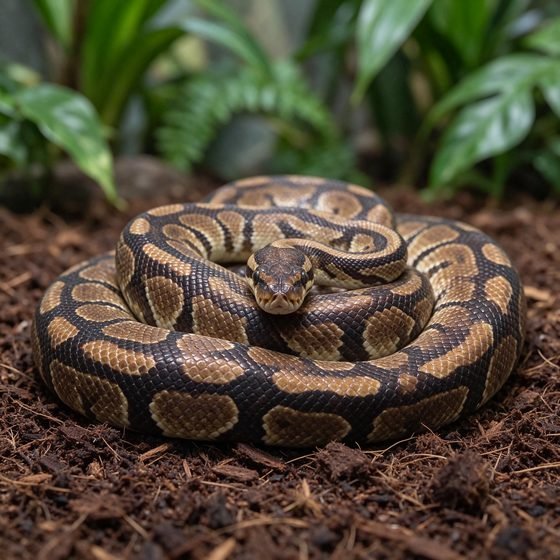
1. The normal shed cycle
Snakes do not shed continuously; they shed in a cycle. The old skin separates from the new layer underneath, the eyes go cloudy as fluid builds between the layers, and then the skin clears again shortly before it comes off. The whole process usually takes about 10–14 days, though it varies with age, growth and health.
Juveniles growing quickly may shed every four to six weeks. Adults often settle into a six-to-eight-week rhythm. A sudden change in frequency is more useful as a signal than a fixed calendar: growth, pregnancy, injury, mites or a change in husbandry can all alter the schedule.
2. What each stage looks like
| Stage | What you see | What to do |
|---|---|---|
| Dull phase | Colours fade; belly scales look grey or pinkish | Raise humidity, keep water clean, reduce handling |
| Blue phase | Eyes cloud over; snake hides; appetite often drops | Do not feed; keep the enclosure quiet and humid |
| Clearing | Eyes look clear again; skin looks tight | Shed is close; check the humid hide and rough surfaces |
| Shedding | Skin lifts from the head and rolls backward | Leave the snake alone; remove the shed once complete |
Not every ball python follows the textbook. Some refuse food for the entire cycle; others eat until the eyes cloud. Offer food only if the snake is willing and the prey is appropriately sized, and never handle a snake in the blue phase just to check on it.

3. Temperature, humidity and the gradient
Heat and humidity fail together. At snake level, a common reference band is a warm hide at 30–32 °C, a cool hide at 22–27 °C and a night drop to roughly 21–26 °C; general air should not exceed 35 °C. Measure the floor inside each hide with an infrared temp gun or a probe resting at snake level, not a dial on the wall. These are typical adult bands, not a prescription for every room: enclosure size, lamp, thermostat, substrate and the individual snake change the setting.
Ball pythons come from tropical West Africa. Most care references put the general humidity range at 60–80%, with a bump to 70–85% during shedding. The exact number matters less than measuring it in the right place: use a digital hygrometer near the substrate, not high on the glass, and keep a second reading at the cool end.
A humid hide is the most reliable tool. Use a plastic container with a hole large enough for the snake, filled with damp sphagnum moss or coco coir. The moss should be damp, not dripping; squeeze it and it should hold together without water running out. Place the hide on the warm side and check it daily during the shed cycle.
Misting the whole enclosure can raise humidity briefly, but it also wets the substrate and invites mould. If the room is very dry, a larger water bowl, a covered screen top and a humid hide are more stable than frequent spraying.

4. Feeding and handling during the cycle
Many ball pythons refuse food when their eyes cloud. That is normal. Offering repeatedly during the blue phase can stress the snake and waste prey. Wait until the eyes have cleared and the shed is complete, then offer the next meal at the normal interval.
Keep handling to essential cleaning. The new skin underneath is delicate, and a snake that is mid-shed may be more defensive. Once the shed is off, give the snake a day to settle before handling or feeding.
5. Checking a shed
A complete ball python shed should be one piece, turned inside out like a sock. Check three places every time:
- Eye caps. Two small, clear discs should be present in the shed. Missing caps can mean retained caps on the snake.
- Tail tip. The thin end is the most common place for retained skin; a constricted tip can lose circulation.
- Vent and belly. Look for a continuous piece, not a patchwork of flakes.
If the shed is in several pieces but the snake looks clean, with clear eyes and a smooth tail tip, it may simply have rubbed against décor. If patches remain, treat it as incomplete.
6. Stuck shed: what actually helps
First, raise humidity and provide a humid hide for 24–48 hours. If skin is still stuck, a short soak in lukewarm water — roughly 24–29 °C, no deeper than the snake’s body — for 20–30 minutes can soften it. Then let the snake move through a damp towel or over rough cork bark. Do not peel the skin yourself, and never pull at an eye cap.
If an eye cap is retained, the eye looks cloudy or dented, the tail tip is swollen, or the snake has had two incomplete sheds in a row, see a reptile veterinarian. Retained eye caps can damage the cornea, and a constricted tail tip can become necrotic.
7. Prevention beats rescue
Most stuck sheds trace back to one of four things: humidity too low, no rough surface to rub against, dehydration, or mites. Check the water bowl, the hygrometer placement and the humid hide before changing anything else. A ball python with a clean, stable enclosure and a proper humidity gradient should not need routine soaking.
SOURCES & REVIEW
- Disorders and Diseases of Reptiles: Dysecdysis — Merck Veterinary Manual.
- Environmental Diseases and Traumatic Injuries of Reptiles — Merck Veterinary Manual.
- Ball Python Humidity and Temperature Requirements — ReptiFiles.
- Ball Python Care Guide — ReptiFiles.
Educational information, not a diagnosis or treatment plan. If your pet is unwell, contact a licensed veterinarian; for an emergency, call the nearest emergency clinic.